Information not found !
Store : Information not found !
category : ( Information not found ! )
Description
:Information not found !
Price : Out of stock



Blog Exporting Iranian Food Products to Canada
Exporting Iranian Food Products to Canada
Admin 8/30/2025
Exporting Iranian Food Products to Canada

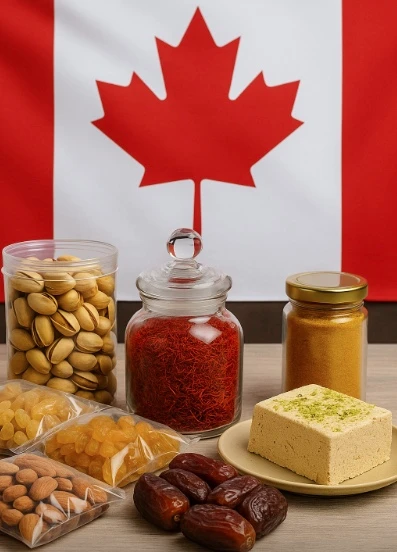
Exporting Iranian Food Products to Canada
Introduction
Canada, with its diverse market and high demand for quality food products, is an attractive destination for food companies. Leveraging its expertise and reputable brand, Buyosell introduces exporters to a secure and consistent process for exporting Iranian products.
Why Export to Canada?
Canada’s multicultural environment and broad acceptance of authentic and flavorful foods provide significant opportunities for products such as dried fruits, spices, sweets, and other Iranian delicacies.
Steps and Requirements for Exporting to Canada
1) Health Requirements and Certification
Exported food products must be produced under sanitary conditions and in compliance with Canadian standards. In some cases, exemptions or permits may be required from the Canadian Food Inspection Agency (CFIA).
Exporters must also apply for a CFIA export certificate, which requires detailed shipment information, such as lot numbers and control measures.
2) Bilingual Labeling Regulations
All essential information—including product name, list of ingredients, nutrition facts table, expiration date, country of origin, and net weight—must appear in both English and French on packaging.
Weights and volumes must be listed in metric units (grams, milliliters, etc.) and be consumer-friendly. Labels written only in numbers and metric units (e.g., “250 g”) are considered bilingual by default.
3) Legal and Regulatory Requirements
Exporters must comply with key laws such as the Food and Drugs Act and the Safe Food for Canadians Act (SFCA), which govern production, packaging, import, and distribution.
A key requirement is to maintain a Preventive Control Plan (PCP) and ensure traceability throughout the supply chain.
4) Using the Export Requirements Library
The CFIA provides a valuable database called the Export Requirements Library, offering detailed information for each destination country and product type, including product eligibility, standards, labeling, and required documentation. Reviewing these resources should be a first step for exporters.
Challenges and Key Considerations
Regulatory Complexity: The wide range of national and international rules requires close attention and consistent monitoring.
Banking and Trade Restrictions in Iran: Working with intermediaries or reputable consulting firms can help manage payments and logistics.
Practical Recommendations for Exporters
Work with experienced trade consultants or companies specializing in Iran–Canada commerce.
Partner with Canadian importers or intermediaries to ensure proper labeling, packaging, and documentation.
Design packaging with clear, readable, bilingual labels.
Establish logistics tracking systems to monitor and trace shipments.
Use tools like PARS (Pre-Arrival Review System) to streamline customs clearance.
Conclusion
Exporting Iranian food products to Canada is a valuable opportunity that can be achieved by adhering to regulations, ensuring proper bilingual labeling, and engaging in strategic partnerships.
If you are interested in starting your export journey with expert support, Buyosell is ready to provide dedicated guidance and professional solutions.
Buyosell – The Direct Trading Platform
Blogs
Stores
Sign up to receive our newsletter
Get the latest information about events, sales, and offers


? Do you have any questions
info@buyosell.net
Contact information
+1 (877)886-1996
604 4849 600
212-707 Como lake ave, Coquitlam, BC
- My account
- Login
- Register
- Forgot Password